
Inflation Calculator
The same number can buy a different life. See what changing prices could mean.
At 3% inflation, prices would be 80.6% higher over this period.
See the annual numbers
| Year | Future cost |
|---|---|
| 0 | $10,000 |
| 1 | $10,300 |
| 2 | $10,609 |
| 3 | $10,927 |
| 4 | $11,255 |
| 5 | $11,593 |
| 6 | $11,941 |
| 7 | $12,299 |
| 8 | $12,668 |
| 9 | $13,048 |
| 10 | $13,439 |
| 11 | $13,842 |
| 12 | $14,258 |
| 13 | $14,685 |
| 14 | $15,126 |
| 15 | $15,580 |
| 16 | $16,047 |
| 17 | $16,528 |
| 18 | $17,024 |
| 19 | $17,535 |
| 20 | $18,061 |
For information and guidance only. Results are illustrative, based on your assumptions, and are not personalised financial advice. Methodology & limitations
Use this to set a future goal
A future budget is different from a budget in today’s money. Keep that distinction clear when setting education or retirement goals.
Which inflation view should I use?
Future cost estimates what something priced today could cost in the future. Use it for a known expense such as education or a major purchase.
Purchasing power shows what an unchanged cash amount could buy in today’s terms after inflation. The account balance itself is not being reduced.
Future monthly income estimates the monthly amount that could buy the same lifestyle as your budget today. It is an income target, not an investment return.
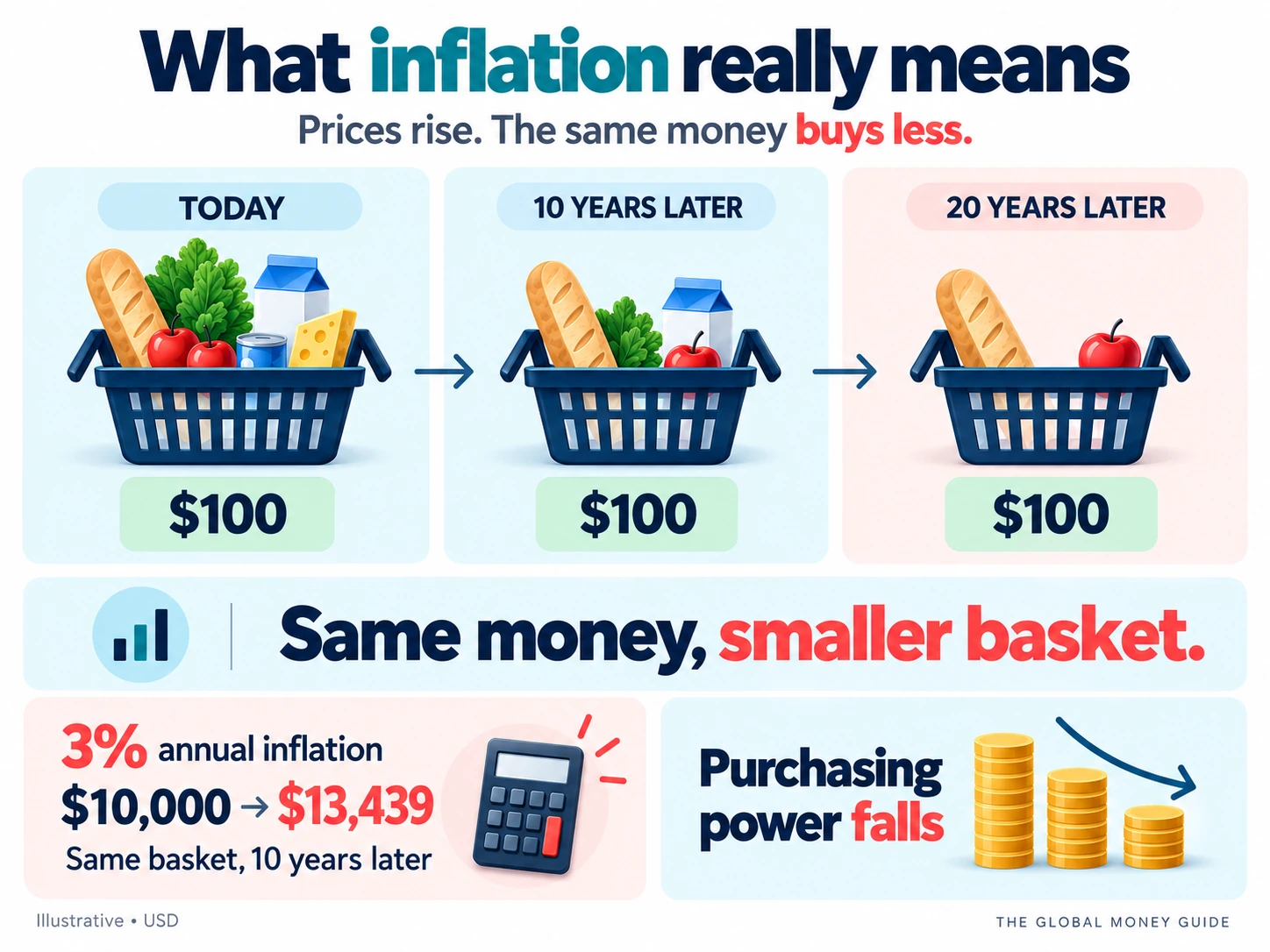
What inflation really means
Prices rise. The same money buys less. Illustrative, USD.
Compare what the same $100 buys today, 10 years later and 20 years later.
Illustrative example: the same basket costing $10,000 today costs $13,439 after 10 years at 3% annual inflation.
Same money, smaller basket.
Future costs and purchasing power explained
Future cost increases a budget by assumed inflation. Purchasing power asks what an unchanged amount could buy. Required future income applies the same inflation factor to the income you want to maintain. These views answer different questions using the same transparent formula.
A worked example with visible assumptions
At 3% annual inflation, a $3,000 monthly budget today becomes $5,418 after 20 years. An unchanged $3,000 would instead have purchasing power of $1,661 in today’s money. This illustrates a constant assumption; actual inflation varies by country and spending pattern.
Apply inflation to retirement spending or plan future tuition and living costs.
Illustrations use the same calculation engines as the tools above. They are not forecasts or personal recommendations.