
Compound Interest Calculator
Explore how a lump sum, monthly saving and time work together.
Questions to put this goal in context
- What is this money ultimately intended for?
- When might you need access to it?
- Would a significant fall in value affect the goal?
For reflection only. You do not need to submit answers.
01Your starting point
Allow for changing prices
Inflation reduces what your future balance can buy. Today’s purchasing power expresses it in current prices.
Advanced settings
The contribution amount is paid once per selected period, not every month. Compounding frequency applies to a nominal annual rate; an effective annual rate already includes compounding. Saving increases at each twelve-month anniversary.
Enter an amount and a time horizon to explore your own scenario.
$0 paid in · $0 assumed growth
For information and guidance only. Results are illustrative, based on your assumptions, and are not personalised financial advice. Assumed returns are not guaranteed; investments can fall as well as rise. Methodology & limitations
Three ways to explore compound growth
Lump sum follows money invested at the start, with no further saving.
Monthly savings / SIP follows regular contributions. SIP means systematic investment plan; the calculation is a regular-saving illustration.
Combined brings starting capital and monthly saving together. Growth is an assumption; actual investments do not grow smoothly.
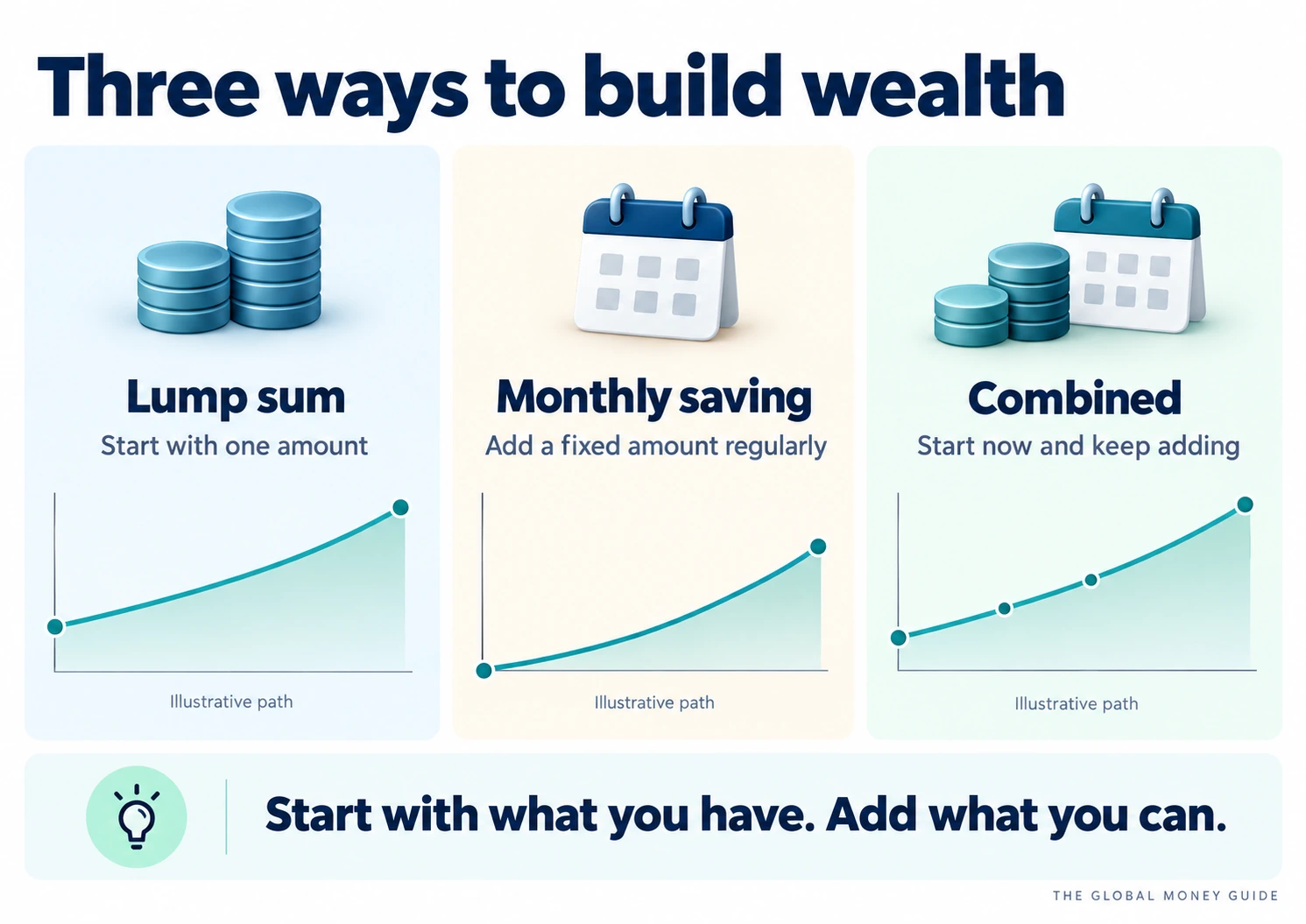
Three ways to build wealth
Illustrative path
Illustrative path
Illustrative path
Start with what you have. Add what you can.
How compound interest changes a savings plan
Your starting capital and regular contributions grow for different lengths of time. Compare money you pay in with assumed growth, and use the inflation setting to see the result in today’s purchasing power. Choose contribution timing and frequency in Advanced settings; use an assumed return after estimated charges.
A worked example with visible assumptions
Start with $10,000, add $500 at each month end for 20 years, and assume a constant 6% effective annual return after estimated charges. The engine illustrates $258,791, including $130,000 paid in. With 3% annual inflation, its purchasing power is $143,286 in today’s money. Tax and market volatility are not modelled.
Give your saving a retirement objective or explore the effect of inflation.
Illustrations use the same calculation engines as the tools above. They are not forecasts or personal recommendations.