
Updated 2026-09-27 · Global · General education
A collection of assets working toward a goal
You do not need dozens of investments, an economics degree or a complicated strategy to have a portfolio. Start with what the money must do, when it may be needed and how much uncertainty the goal can tolerate.
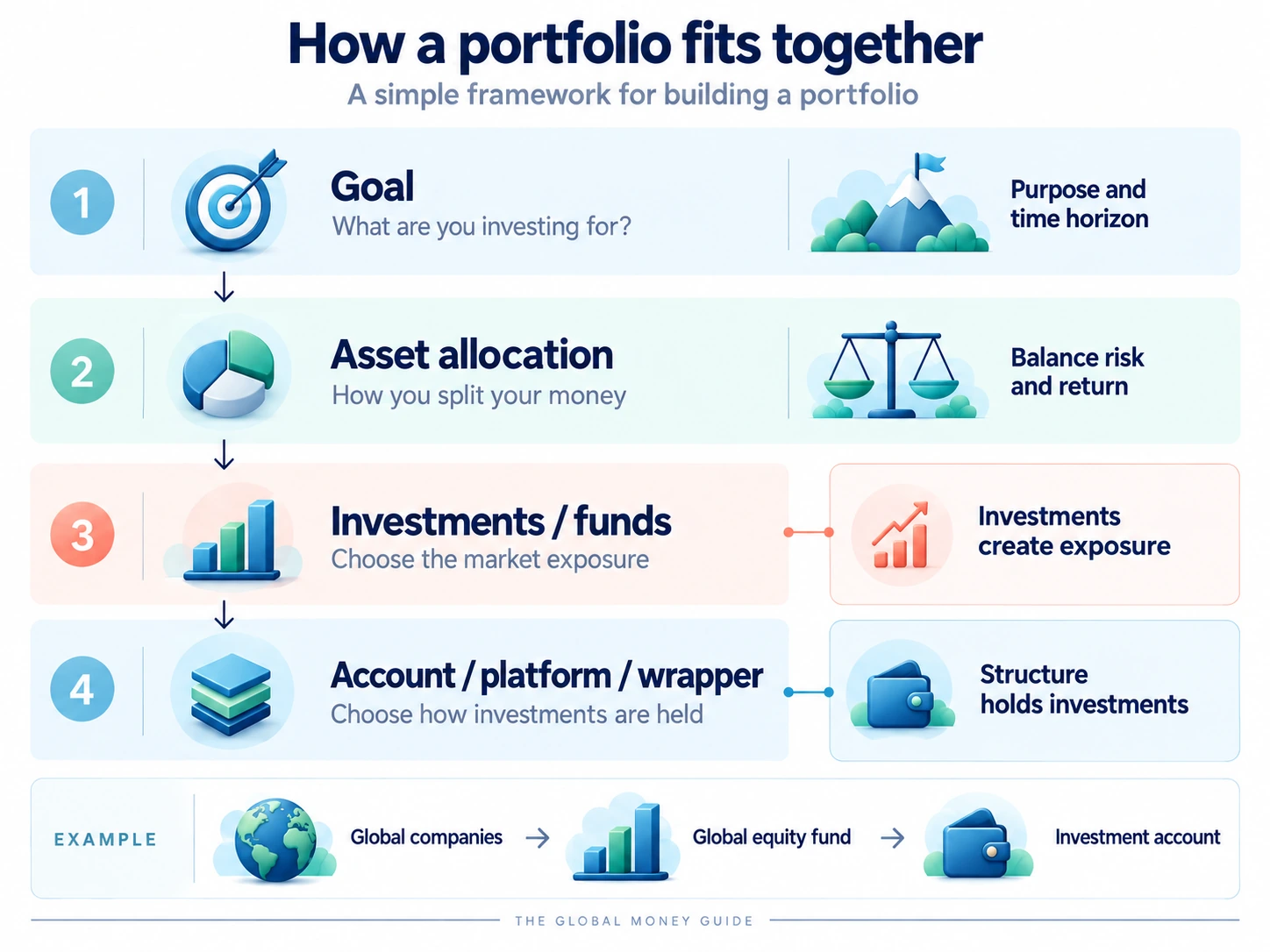
How a portfolio fits together
A simple framework for building a portfolio
1. Goal: What are you investing for? Connect this to purpose and time horizon.
2. Asset allocation: How you split your money. Balance risk and return.
3. Investments and funds: Choose the market exposure. Investments create exposure.
4. Account, platform or wrapper: Choose how investments are held. Structure holds investments.
Example: exposure to global companies through a global equity fund held in an investment account.
I already invest
Map the holdings, their purpose, overlap, concentration, fees and access. Then ask whether the mix still fits.
I am starting
Set the goal and time horizon, assess access needs, choose an asset allocation, then investments and a holding structure.
What the building blocks give you access to
| Investment | What it gives you access to | How it may be used | What to understand |
|---|---|---|---|
| Shares | Ownership in businesses | Long-term capital growth and dividend income | Company, sector, valuation and market exposure |
| Bonds | Lending to governments or companies | Income, diversification and differing stability characteristics | Interest rates, maturity, credit and currency |
| Cash | Liquidity and nominal stability | Emergencies, planned expenditure and near-term commitments | Inflation, deposit arrangements and access |
| Mutual funds | A pool of investments managed to a mandate | Access to a strategy or diversified set of holdings | Underlying assets, mandate, charges and dealing terms |
| ETFs | A fund traded on an exchange | Market or strategy exposure with exchange trading | Holdings, index or active approach, spreads and liquidity |
| REITs | Property businesses or property-related assets | Property exposure and potential distributions | Property sector, debt, rates and market pricing |
| Alternatives | A wide range of non-traditional exposures | Specific return sources or portfolio roles | Strategy, valuation, leverage, liquidity and fees |
| Structured notes | A contractual payoff linked to reference assets | Conditional income or a defined return pattern | Coupon conditions, barriers, issuer, maturity and exit terms |

Diversification is more than a longer investment list
Look across companies, industries, countries, currencies and asset classes. Three funds can still depend heavily on the same large technology shares. Employer stock plus a technology fund can also create overlap that is easy to miss.
Diversification can reduce dependence on a single outcome; it cannot prevent all losses. Relationships between assets can change, especially during stressed markets. Rebalancing means periodically returning to an intended mix, taking account of costs, tax and changed circumstances.
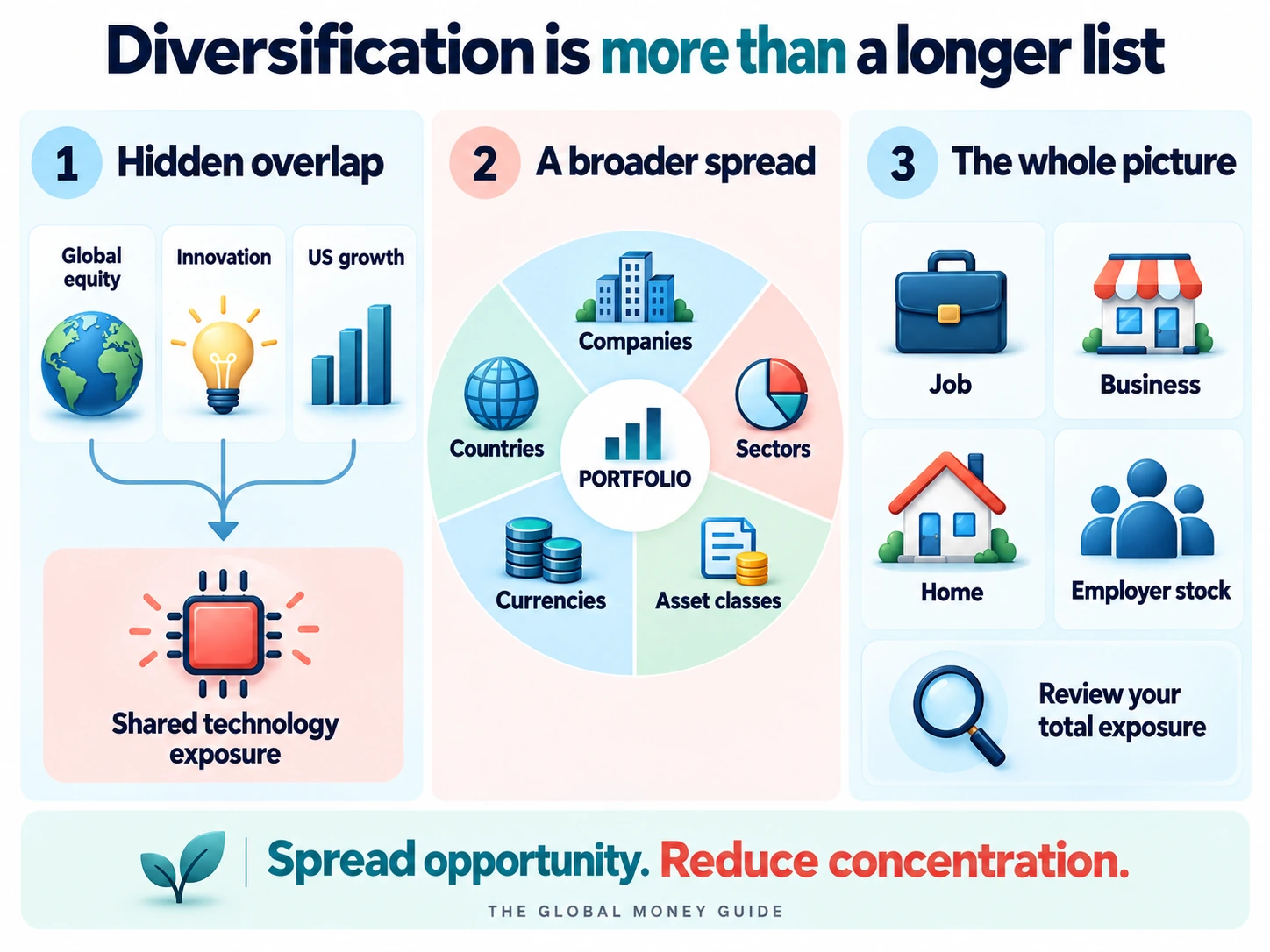
Diversification is more than a longer list
Check hidden overlap, seek a broader spread and review the whole picture.
Global equity, innovation and US growth can share technology exposure.
Consider companies, sectors, asset classes, currencies and countries across the portfolio.
Review your total exposure, including your job, business, home and employer stock.
Spread opportunity. Reduce concentration.
Mutual funds, ETFs and UCITS: avoid mixing the labels
Mutual funds and ETFs can hold many kinds of assets and can use active or index-based approaches. A broad index fund and a narrowly focused sector fund have different concentration risks even when both are ETFs. Check the mandate and holdings rather than relying on the label.
UCITS means Undertakings for Collective Investment in Transferable Securities. It is a European regulatory framework for funds with requirements around eligible investments, diversification, disclosure and safekeeping. A UCITS fund may be an ETF or another fund form. UCITS is not an asset class, a guarantee of capital or proof that a fund suits your needs.
Capital growth, income and total return
Capital growth means an increase in the value of the holding. Income can include interest, dividends and fund distributions. Total return considers both, and an investment can pay income while its price falls. A high distribution rate is not automatically a high economic return.
Accumulating fund units generally reinvest income within the fund; distributing units pay it out. The useful choice depends on access needs, costs and tax treatment. Selling units can also create cash flow, but withdrawals during a downturn can reduce the assets left to recover. Income should be considered alongside the sustainability of the whole portfolio.
Bonds and deposits are not interchangeable
A fixed coupon describes an interest payment, not a fixed resale price. A bond’s market value can change as interest rates and the issuer’s credit position change. A bond fund normally has no single maturity date on which your purchase price must be returned. Foreign-currency bonds add exchange-rate exposure.
A bank deposit has different contractual and regulatory features. Fixed-term deposits can restrict early access, and any protection depends on the bank, jurisdiction, eligible depositor and scheme limits. A money-market fund is an investment fund, not simply a protected bank account.
Structured notes create a defined return pattern
A note can complement other holdings through a payoff linked to specified market conditions. Understand the reference assets, observation dates, coupons and maturity outcome before deciding where it might fit. The contract and issuer matter as much as the market view.
Connect the investment mix to the goal
Cash for next year’s tuition has a different job from assets for retirement decades away. Consider how much money must be accessible, when it is needed, the currency of the bill and how a fall in value would affect the goal. Willingness to accept volatility and financial ability to absorb loss are not always the same.
A household can also be concentrated outside its investment accounts. Employment, a business and local property may all depend on one country or sector. Review the whole picture before deciding whether a new holding adds useful diversification.
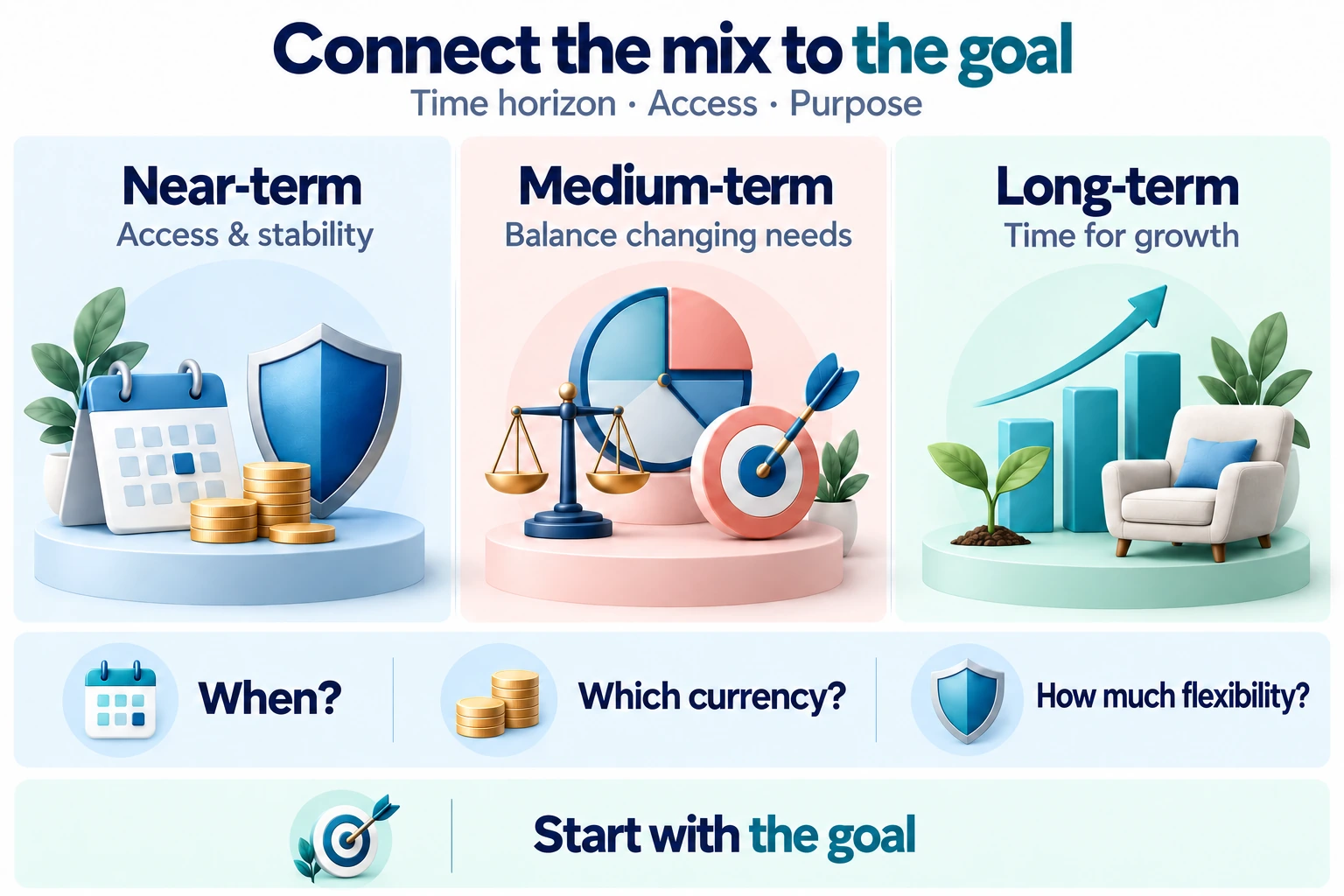
Connect the mix to the goal
Time horizon, access and purpose
Access and stability
Balance changing needs
Time for growth
Questions to connect the mix to the goal
Start with the goal.
Rebalancing brings the mix back to the plan
Different holdings change value at different speeds. Periodically compare the resulting mix with the allocation you intended. Contributions, withdrawals or trades can bring it closer to that plan, allowing for costs and any tax consequences. This is a review of the plan, not a prediction of the next market move.
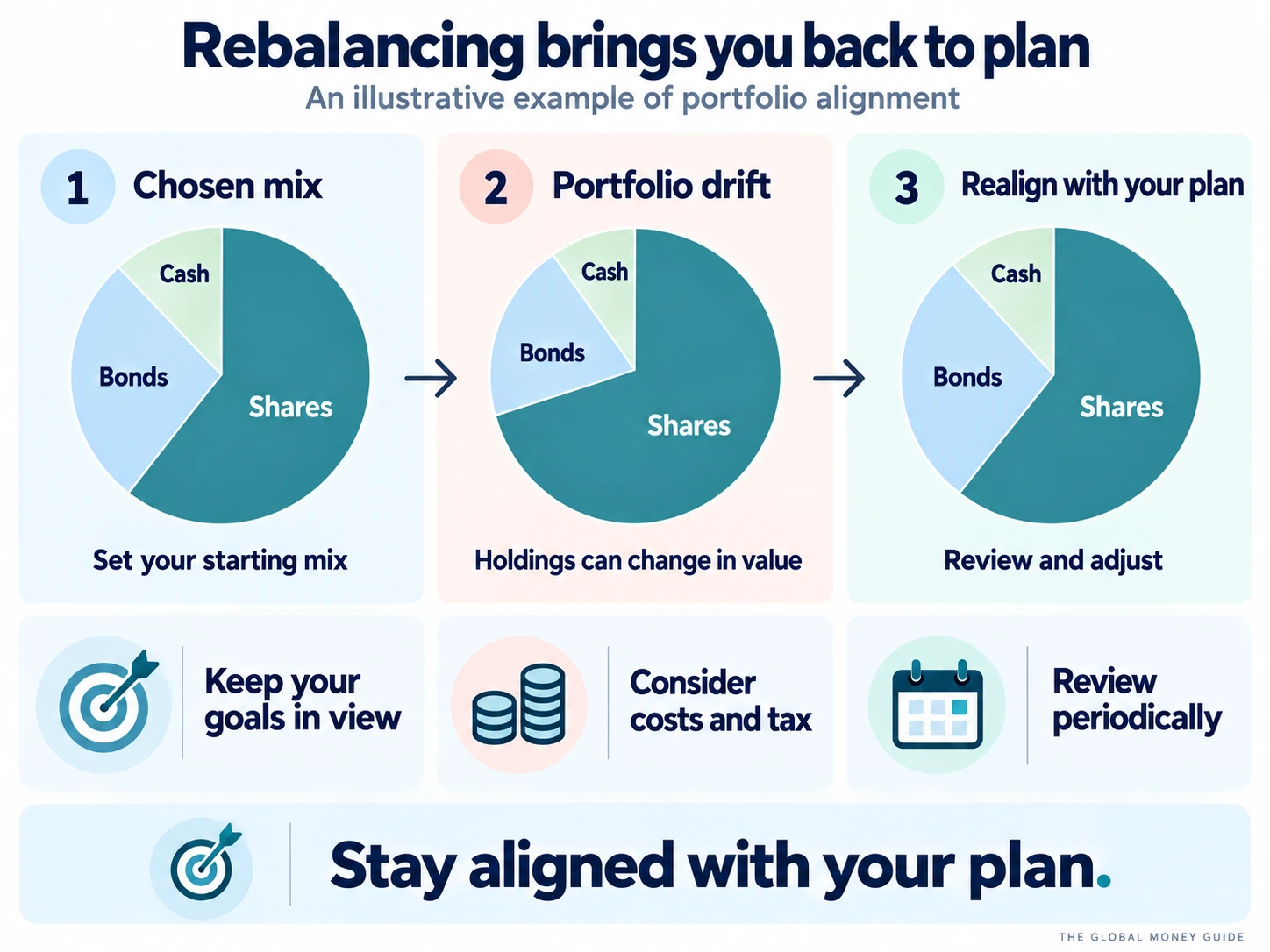
Rebalancing brings you back to plan
An illustrative example of portfolio alignment
Start with your chosen mix. Holdings can change in value and cause portfolio drift. Review and adjust to realign with your plan.
Set your starting mix: shares, bonds and cash.
Holdings can change in value.
Review and adjust.
Stay aligned with your plan.
Questions worth taking into a portfolio review
What do I actually own, and where do the holdings overlap? Which costs sit at the fund, account and advisory levels? How quickly can I access money, and at what cost? How would a market fall affect a payment I cannot postpone? What changes if I move country?
Keep the investment choice separate from the structure holding it. The International Investing Structures Guide explains ownership, custody, platforms and insurance-based arrangements. The Compound Growth Calculator can explore assumptions, but it does not select investments or measure your personal tolerance for loss.
See what may deserve a closer look
Sources and scope
General investment concepts. Product terms, regulation and tax treatment vary by jurisdiction.
- Investor.gov — asset allocation and diversification · Checked 2026-09-27 · Global
- Investor.gov — mutual funds · Checked 2026-09-27 · Global
- Investor.gov — exchange-traded funds · Checked 2026-09-27 · Global
- Investor.gov — REITs · Checked 2026-09-27 · Global
- ESMA — UCITS framework · Checked 2026-09-27 · Global
- FINRA — structured notes and principal protection · Checked 2026-09-27 · Global
Educational reference; no asset allocation, product or personal suitability recommendation.
For information and guidance only. Results are illustrative, based on your assumptions, and are not personalised financial advice. Methodology & limitations