
Updated 2026-09-27 · Global · General education
What a structured note is designed to do
A structured note creates a predefined payoff linked to the performance of a market, index, share, basket or other reference asset. It can be designed for potential income, conditional returns or a particular market exposure, sometimes alongside other portfolio holdings.

Read the contract in plain English
| Term | Meaning |
|---|---|
| Reference asset | The market measure or investment used to calculate payments |
| Coupon | A payment that may be fixed or conditional on stated tests |
| Observation date | A date when a condition is checked |
| Barrier | A level used in a coupon or capital calculation; timing of the test matters |
| Autocall | An early repayment feature if a specified condition is met |
| Maturity | The scheduled end of the note |
| Worst-of | The least favourable reference-asset performance drives a specified test or payment |
Four outcomes from one set of terms
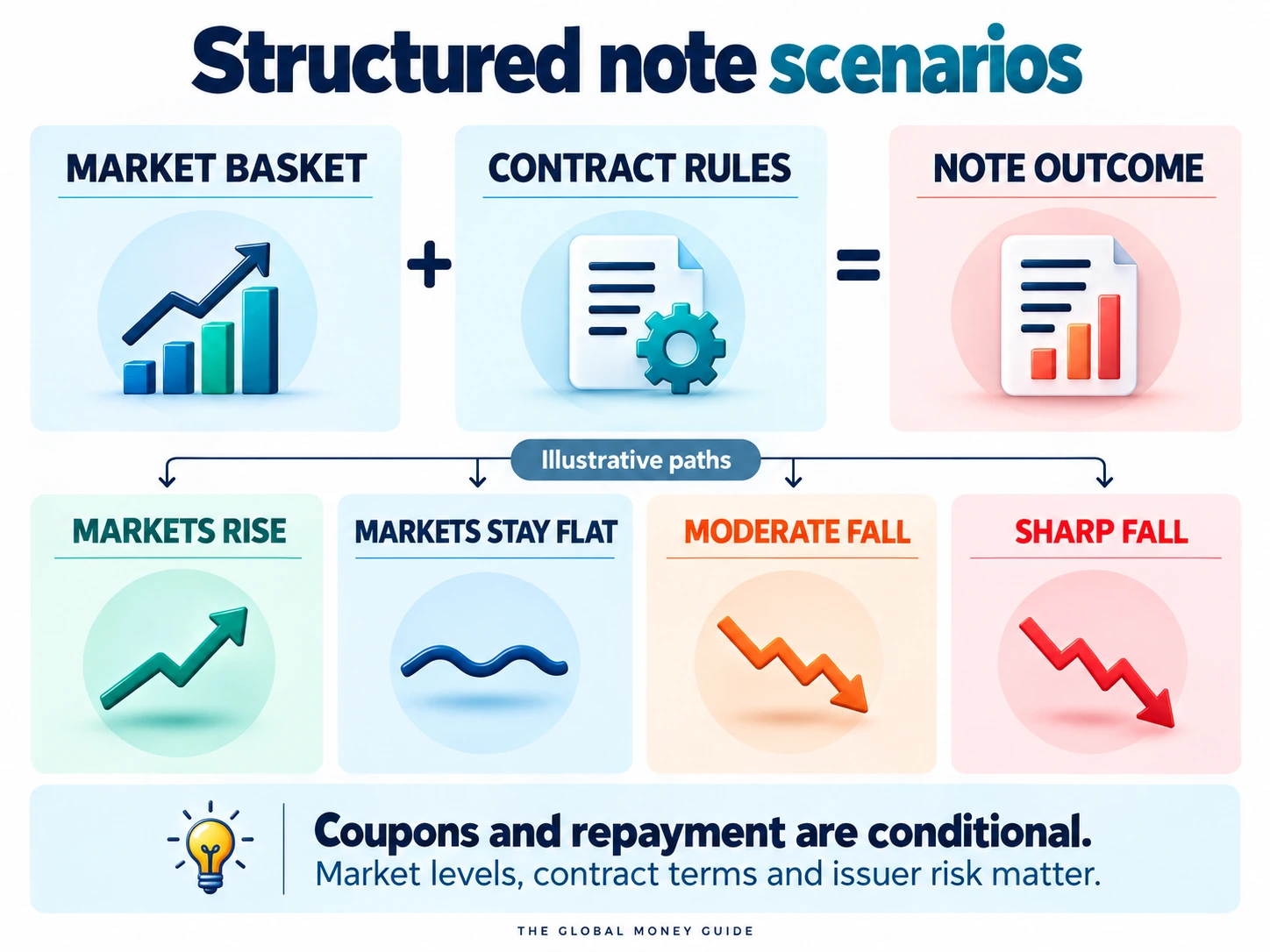
Structured note scenarios
Market basket + contract rules = note outcome
Illustrative paths
Coupons and repayment are conditional. Market levels, contract terms and issuer risk matter.
Where might this fit within the rest of the portfolio?
The attraction is the ability to design a return pattern around defined market conditions. It does not remove investment risk. A strong rise may pay no more than the contracted coupon; a material fall can cause a capital loss. An early autocall, where included, can also change the time for which money remains invested.
Review issuer credit quality, concentration, embedded costs and early-sale terms. A barrier is not the same as a guarantee; even a contractual principal promise depends on the issuer meeting its obligations. Use the actual term sheet to model outcomes.
Compare the job with the rest of your holdings
Sources and scope
General education and illustrative assumptions; personal tax and legal treatment require current local review.
- FINRA — Understanding structured notes · Checked 2026-09-27 · US investor education; contract terms vary
Illustrations are not forecasts or personal recommendations.
For information and guidance only. Results are illustrative, based on your assumptions, and are not personalised financial advice. Methodology & limitations