
Updated 2026-09-27 · US · General education
Start with an asset inventory
A US company share, a fund investing in the US and a non-US account are different layers. Record exactly what is owned before drawing conclusions from the broker’s address or a dollar valuation.
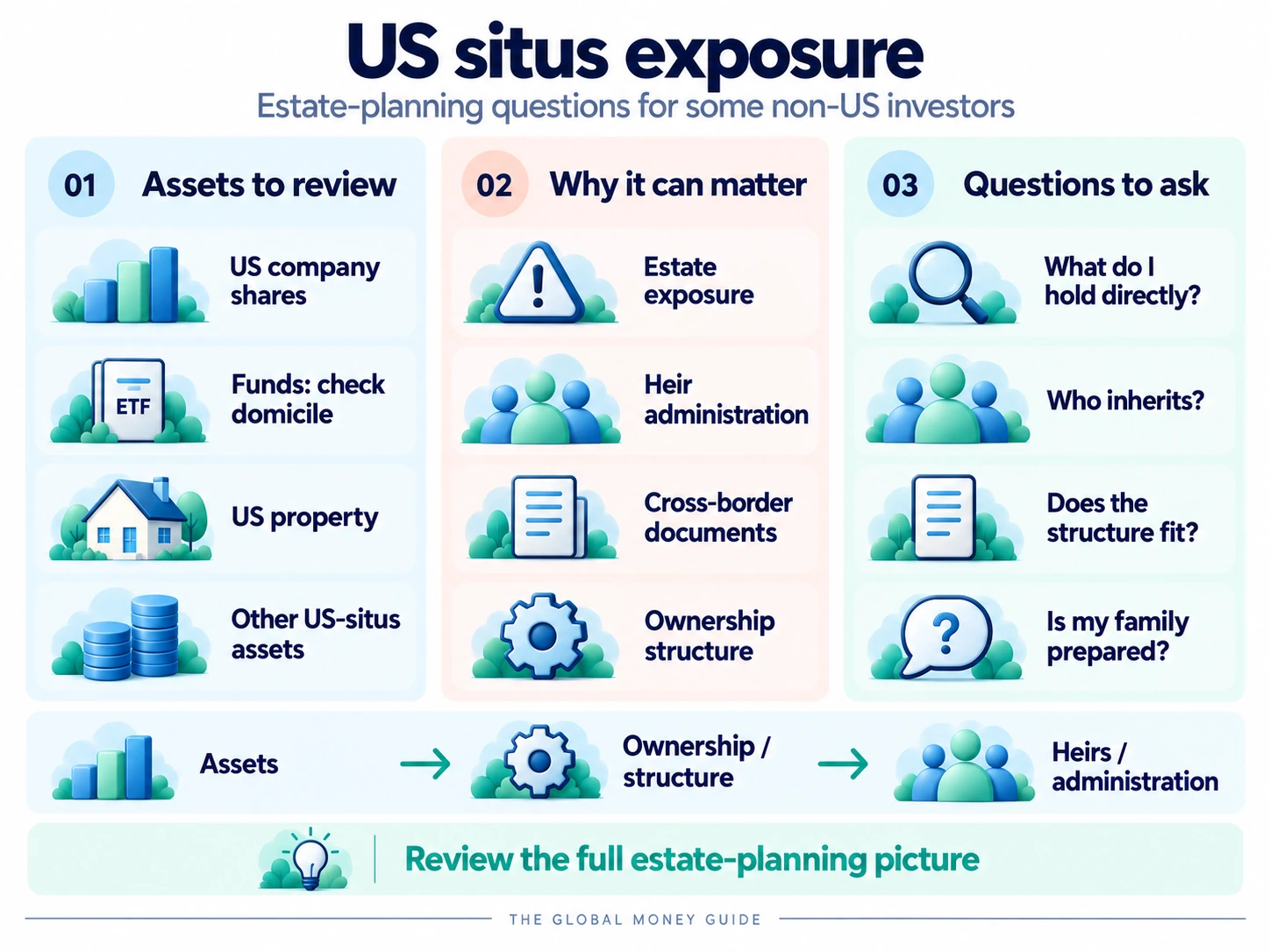
US situs exposure
Estate-planning questions for some non-US investors
US company shares; funds, checking domicile; US property; other US-situs assets.
Estate exposure; heir administration; cross-border documents; ownership structure.
What do I hold directly? Who inherits? Does the structure fit? Is my family prepared?
Consider the assets, then their ownership and structure, then heirs and administration.
Review the full estate-planning picture.
Residence and asset location are different questions
A person can live outside the United States and still directly own an asset treated as situated in the United States for estate-tax purposes. This is why the legal nature and location of the asset matter.
- Direct shares in US corporations can be important.
- US real property can be relevant.
- Employee equity can become relevant once it converts into directly owned shares.
Do not reduce the analysis to one threshold
The widely discussed filing threshold is not the same thing as a simple tax-free allowance or a flat tax calculation. Treaties, deductions, ownership and the wider estate can all affect the analysis.
- Identify whether a treaty may apply.
- Map direct US-situated holdings.
- Review ownership through brokers, nominees and wrappers rather than assuming the platform location decides situs.
Structures need legal and tax analysis
An international account or wrapper does not automatically remove US-situs exposure. The key question is what the investor legally owns and how the structure is treated in the relevant jurisdictions.
Connect ownership with the wider family plan
Sources and scope
US nonresident/noncitizen estate concepts; IRS source checkpoint 25 September 2026. Estate-tax residence, treaties, ownership and filing facts require separate review.
- IRS — US-situated assets and nonresident estate returns · Checked 2026-09-27 · US
General information; does not establish individual eligibility, tax treatment or suitability.
For information and guidance only. Results are illustrative, based on your assumptions, and are not personalised financial advice. Methodology & limitations