

Updated 2026-09-27 · US · General education
A high income does not automatically create a diversified plan
Salary, bonus, shares, options, pension and career prospects may all depend on the same employer. The planning question is how employer-created wealth can become independent family wealth.
Separate the shared exposures
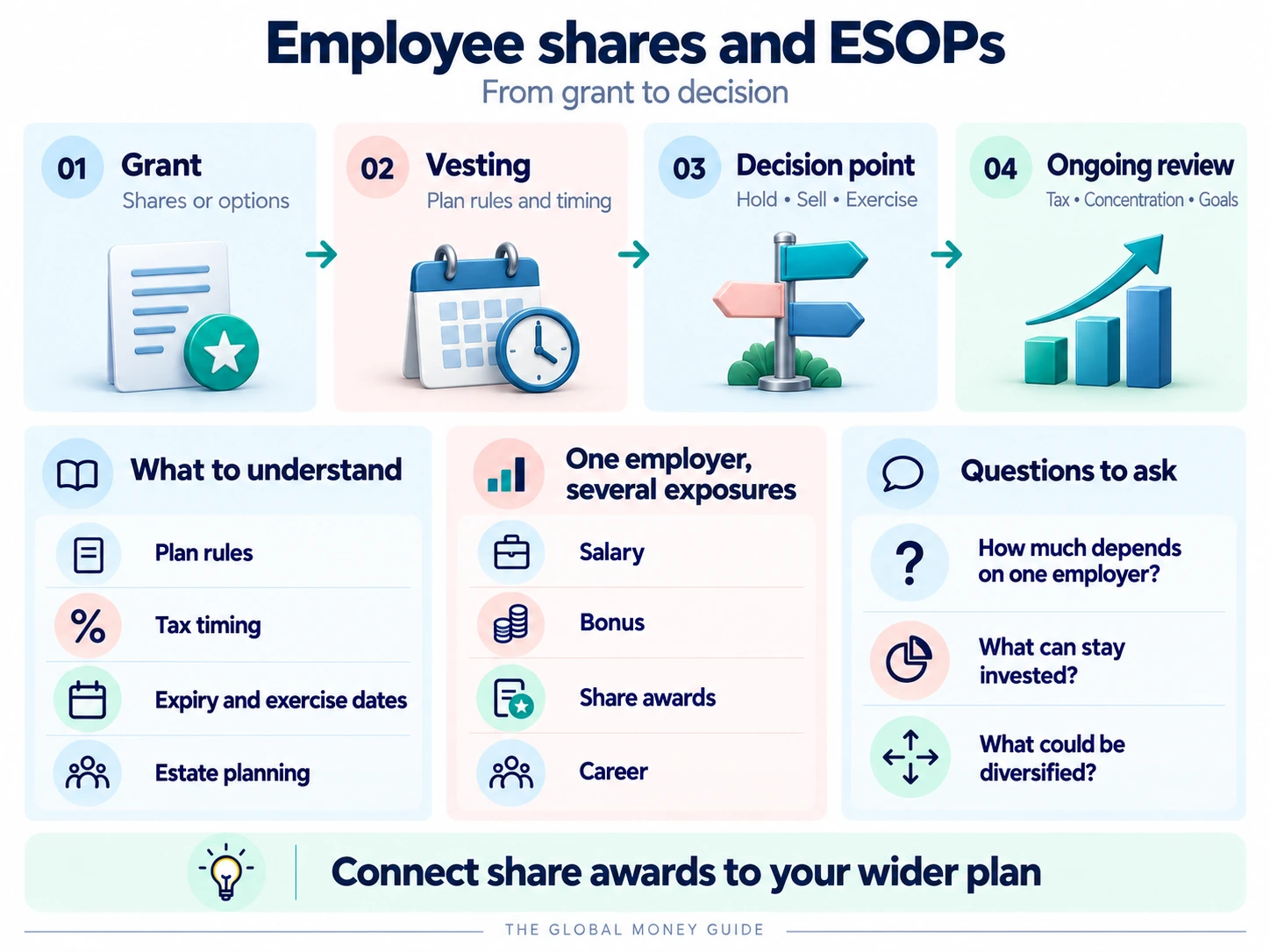
Employee shares and ESOPs
From grant to decision
The sequence is grant, vesting, decision point and ongoing review.
Shares or options
Plan rules and timing
Hold, sell or exercise
Tax, concentration and goals
Plan rules; tax timing; expiry and exercise dates; estate planning.
Salary, bonus, share awards and career.
How much depends on one employer? What can stay invested? What could be diversified?
Connect share awards to your wider plan.
Separate the award from the share
Employee equity can move through several legal stages: grant, vesting, exercise and direct share ownership. Those stages should not automatically be assumed to have identical tax or estate treatment.
- Identify what is vested and unvested.
- Identify the legal issuer of the shares.
- Confirm where the shares are held and what happens on death.
Concentration can grow quietly
A successful employee can accumulate a large position in one employer without making a deliberate portfolio-allocation decision. Salary, career prospects and investments can all become linked to the same company.
- Measure employer shares as a percentage of total investable wealth.
- Understand dealing windows and liquidity restrictions.
- Coordinate diversification with tax and vesting considerations.
Cross-border estate questions can be missed
For non-US employees of US companies, directly owned shares in a US parent can create a situs question even when the employee lives in India, the GCC, Europe or Asia.
- Review vested direct shares separately from unvested awards.
- Check beneficiary and succession arrangements.
- Take tax advice before restructuring or selling solely for estate reasons.
Understand the award before valuing the plan
| Term | What it usually means | What to verify |
|---|---|---|
| Grant | An award is offered under a plan | Acceptance, conditions and plan documents |
| Vesting | Conditions for entitlement have been met | Settlement date, forfeiture and restrictions |
| RSU | A promise to deliver shares or cash subject to terms | Whether and when shares actually settle |
| Option | A right to buy shares at an exercise price | Exercise cost, expiry and tax timing |
| ESOP | A label used differently across countries | The actual legal plan, not just its acronym |
| Direct shares | An ownership interest in the issuer | Issuer domicile, account title and succession |
The chain from compensation to family wealth
Grant, vesting, exercise and settlement are separate events. An unvested award is not automatically equivalent to freely tradable shares. An option may require cash to exercise, and the tax event may not coincide with a later sale. Cash-settled awards can behave differently from share-settled awards. The plan documents and the countries involved determine the treatment.
After settlement or exercise, directly owned US corporate shares can introduce a different estate and succession question from employment income. A non-US employee does not become a US citizen by holding those shares, but the asset itself still requires review.
A concentration example
Suppose an employee has $120,000 of directly owned employer shares and $80,000 in other investments. Employer shares represent 60% of those invested assets, before counting unvested awards or the salary tied to the same business. A 30% fall in that shareholding would reduce the combined $200,000 by $36,000, or 18%, if other investments were unchanged. This arithmetic illustrates concentration; it is not a forecast or a sell instruction.
Diversification decisions should consider the whole position, dealing windows, tax, liquidity and upcoming goals. A successful employer can still be an uncomfortable source of concentration when education or retirement depends on the same company.
What does the US estate question involve?
IRS guidance generally treats shares of corporations organised under US law as US-situated, even when certificates are held abroad or registered to a nominee. For a nonresident who is not a US citizen, the Form 706-NA filing threshold can be triggered when US-situated assets and relevant adjustments exceed $60,000. This threshold is not a universal tax-free allowance and is not a calculation of the tax due.
Treaties, domicile, deductions, ownership and local law can change the analysis. Unvested awards and options need specific treatment under their terms; do not assume the conclusion for direct shares applies to every award. Do not transfer or restructure awards on the basis of a generic article.
Prepare for a useful conversation
Bring an award summary, vesting calendar, exercise prices and expiry dates, where relevant. Add current shareholdings, broad future spending goals and the countries in which you work, live or expect to move. Sensitive documents should be exchanged only through an appropriate secure process after the initial meeting request.
The discussion can separate four decisions: understanding what you own, managing concentration, organising accessible money for goals, and coordinating tax and succession advice. A product is only one possible part of that wider plan.
Turn concentration into a planning question
Sources and scope
US nonresident/noncitizen estate concepts; IRS source checkpoint 25 September 2026. Estate-tax residence, treaties, ownership and filing facts require separate review.
- IRS — estate tax for nonresidents who are not US citizens · Checked 2026-09-27 · US
- IRS — US-situated assets and filing requirements · Checked 2026-09-27 · US
- HMRC — Employment-related securities for internationally mobile employees · Checked 2026-09-27 · UK; other countries have their own rules
General information; does not establish individual eligibility, tax treatment or suitability.
For information and guidance only. Results are illustrative, based on your assumptions, and are not personalised financial advice. Methodology & limitations