Updated 2026-09-27 · Global · General education
You do not need dozens of investments
A portfolio is simply a collection of financial assets working toward one or more goals. You do not need an economics degree or a complicated strategy. You need to understand what each part is there to do.
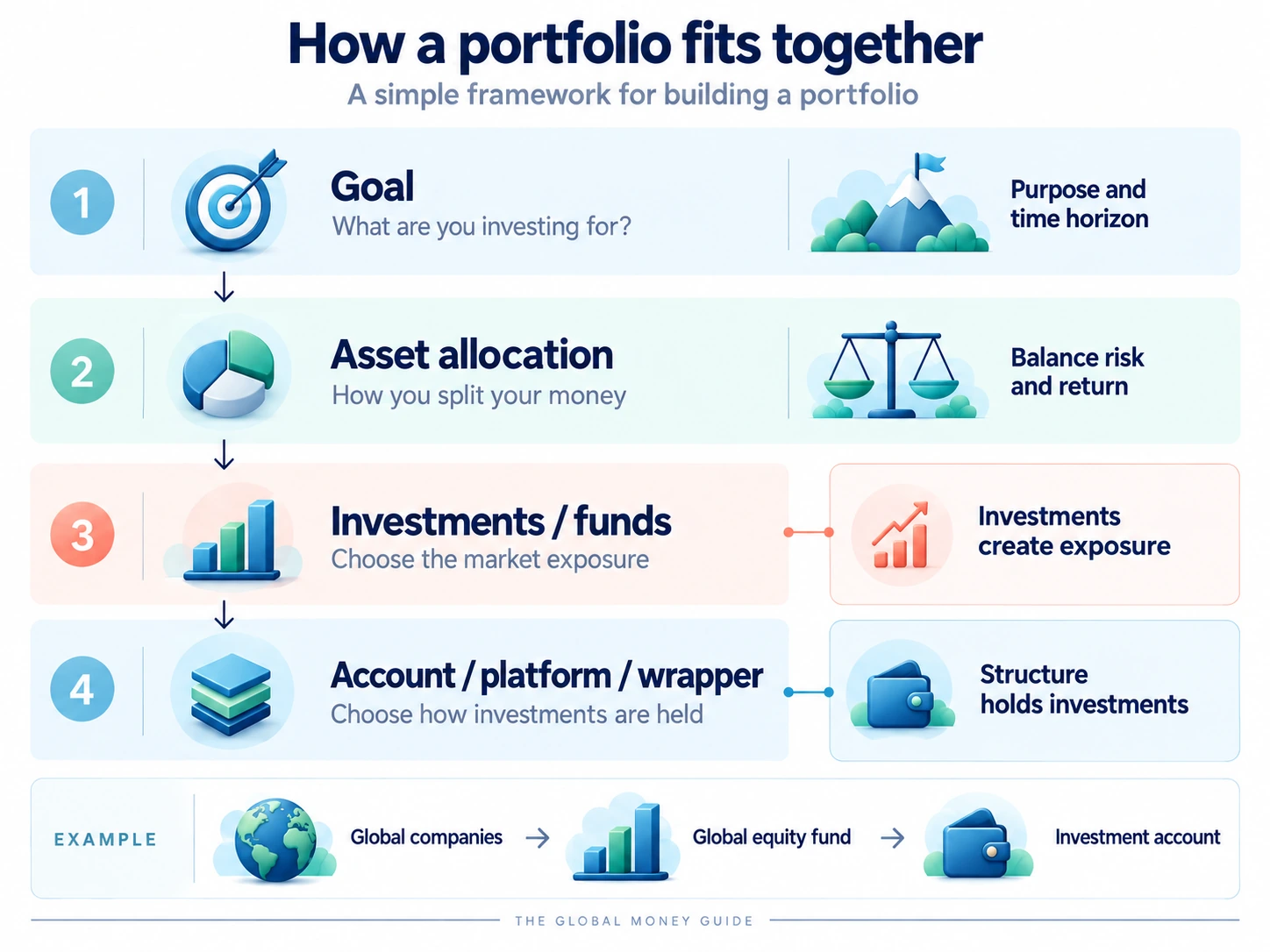
How a portfolio fits together
A simple framework for building a portfolio
1. Goal: What are you investing for? Connect this to purpose and time horizon.
2. Asset allocation: How you split your money. Balance risk and return.
3. Investments and funds: Choose the market exposure. Investments create exposure.
4. Account, platform or wrapper: Choose how investments are held. Structure holds investments.
Example: exposure to global companies through a global equity fund held in an investment account.
Five funds can still mean one big exposure
If several funds own many of the same large companies, the labels may look more diverse than the underlying holdings. Look through to companies, sectors, countries and currencies. Diversification spreads exposure; it cannot prevent every loss.
Choose your starting point
I already invest
Map what you own, look for overlap and concentration, and connect each holding to a goal.
I am starting
Decide when you need the money, how much access you need and what fall in value the goal could withstand.
Continue with your own portfolio
For information and guidance only. Results are illustrative, based on your assumptions, and are not personalised financial advice. Methodology & limitations